
How Are You Directing the Attendee Journey?
Walk any trade show floor and you will see it immediately. People passing by without stopping. Standing just outside a booth, watching but not engaging. Nodding through conversations without contributing. Scanning badges after a giveaway, then moving on. None of this is unusual. In fact, it is what most events look like. But it raises a more important question. How much of this behavior was actually designed?
Because whether intentional or not, every event is shaping behavior. The only difference is whether it is being directed or left to chance. Most attendee journeys are not mapped. They are assumed. The expectation is that if the booth looks good, the messaging is clear, and the team is trained, the right interactions will happen. Sometimes they do. Most of the time, they do not.
What is often missed is that engagement is not a single moment. It is a progression. Someone notices something. They decide whether to stop. They assess whether it is worth their time. They choose whether to engage. They decide whether to stay or leave. Each of these is a decision point, and each one can either move someone forward or lose them entirely.
Most event environments allow for passive behavior. They do not require anything from the attendee. Watching is enough. Listening is enough. Taking something and leaving is enough. But passive behavior does not drive results. Active behavior does. It is the difference between someone observing your brand and someone engaging with it. Between a surface-level interaction and a meaningful conversation. Between collecting a lead and creating an opportunity.
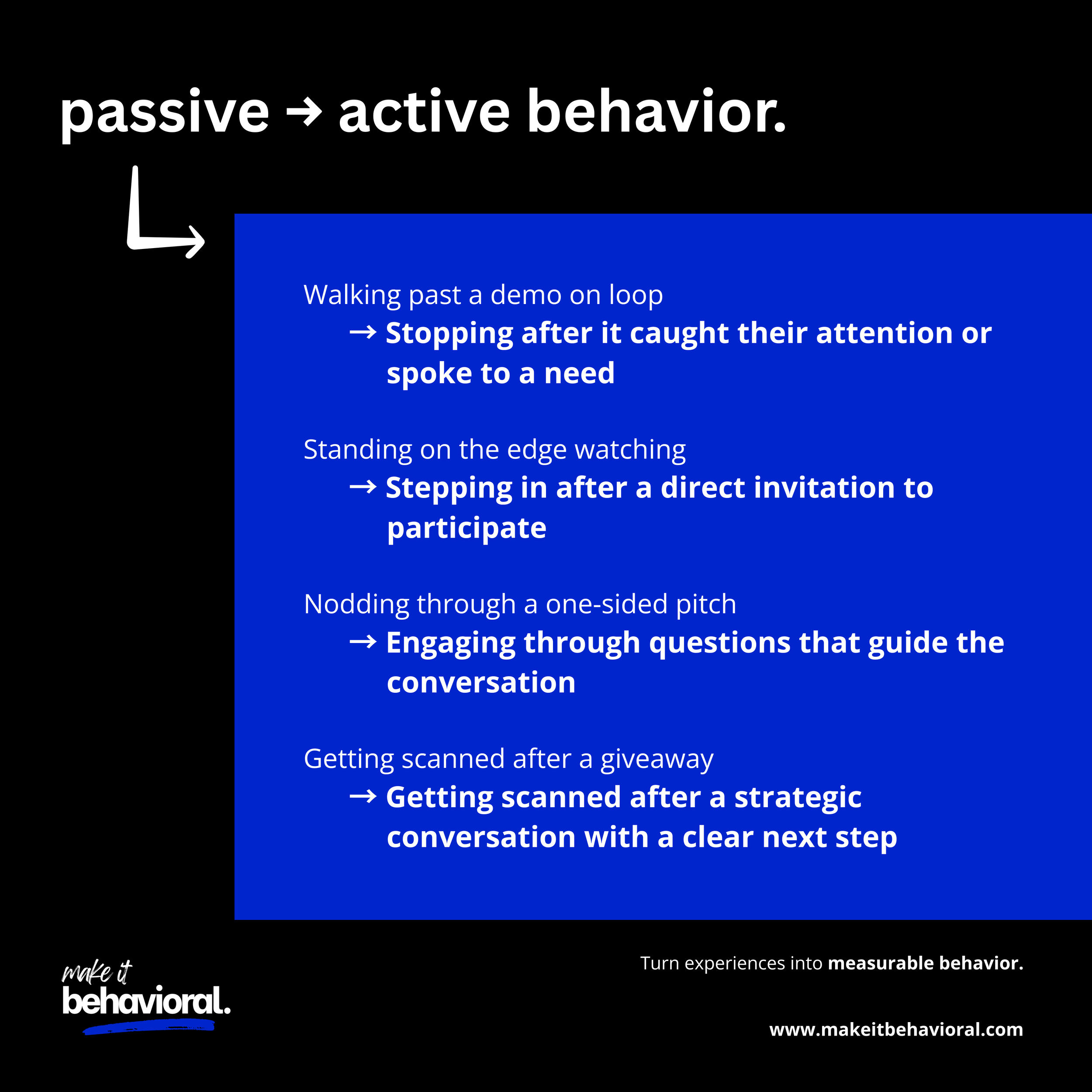
The goal is not to eliminate passive behavior entirely. It is to create clear, intentional pathways that guide people out of it. A demo running on loop does not create engagement on its own, but something within that moment can be designed to pull someone in. Standing on the edge of a booth is not engagement, but a well-timed invitation can turn observation into participation. A one-sided pitch does not create connection, but guided questions can shift the interaction into a conversation. A badge scan alone does not create value, but a structured exchange with a clear next step can.
These are small shifts, but they change everything. When attendee journeys are intentionally designed, behavior becomes more predictable. People stop more often. They engage more deeply. Conversations become more relevant. Outcomes become more measurable. Not because more activity was added, but because existing interactions were designed with purpose.
This is what directing the attendee journey actually means. Not controlling every movement but creating an environment where the right behaviors are more likely to happen. Because when behavior is left to chance, results are inconsistent. When it is designed, performance follows.
